With the proliferation of true-crime shows over the last couple of decades, it’s never been more evident that America and beyond can’t get enough of stories that are ripped from the headlines. True crime has always fascinated audiences, but over the last several decades, the scandalous lives of real criminals, their crimes, and the effect they have on the lives of their victims and their families have skyrocketed. The film industry has never shied away from capitalizing on the sensational nature of true crime on the big screen. Some films executed the adaptation from the headlines to film better than others.Capoteis one that did it with tremendous aplomb.Truman Capote’s novel,In Cold Blood, is the story of the random murder of the Clutter family in a small town in Holcomb, Kansas, and chronicles how it made him the most famous writer in the country. WithPhilip Seymour Hoffmanportraying the eccentric, flamboyant Capote, the film succeeds in every aspect of what makes true crime stories so easy for audiences to latch onto.
RELATED:From ‘Boogie Nights’ to ‘Capote’: Philip Seymour Hoffman’s 15 Best Performances
The Clutter Family Murders
Unfortunately, the first ingredient in any intriguing story about a real crime is a horrifically gruesome and salacious event. In 1959, when two drifters, Perry Smith (Clifton Collins Jr.) and Richard “Dick” Hickok (Mark Pellegrino), entered a quiet farmhouse in a small Kansas town and gunned down the Clutter family, it made national news for its randomness and sheer brutality. After a botched robbery attempt, each member of the Clutter family was shot in the face with a shotgun. That type of subhuman brutality is what caught Capote’s attention all the way in New York City and got him to promptly board a train to Kansas to see what he could dig up for a new novel.
We Need to Know Every Detail
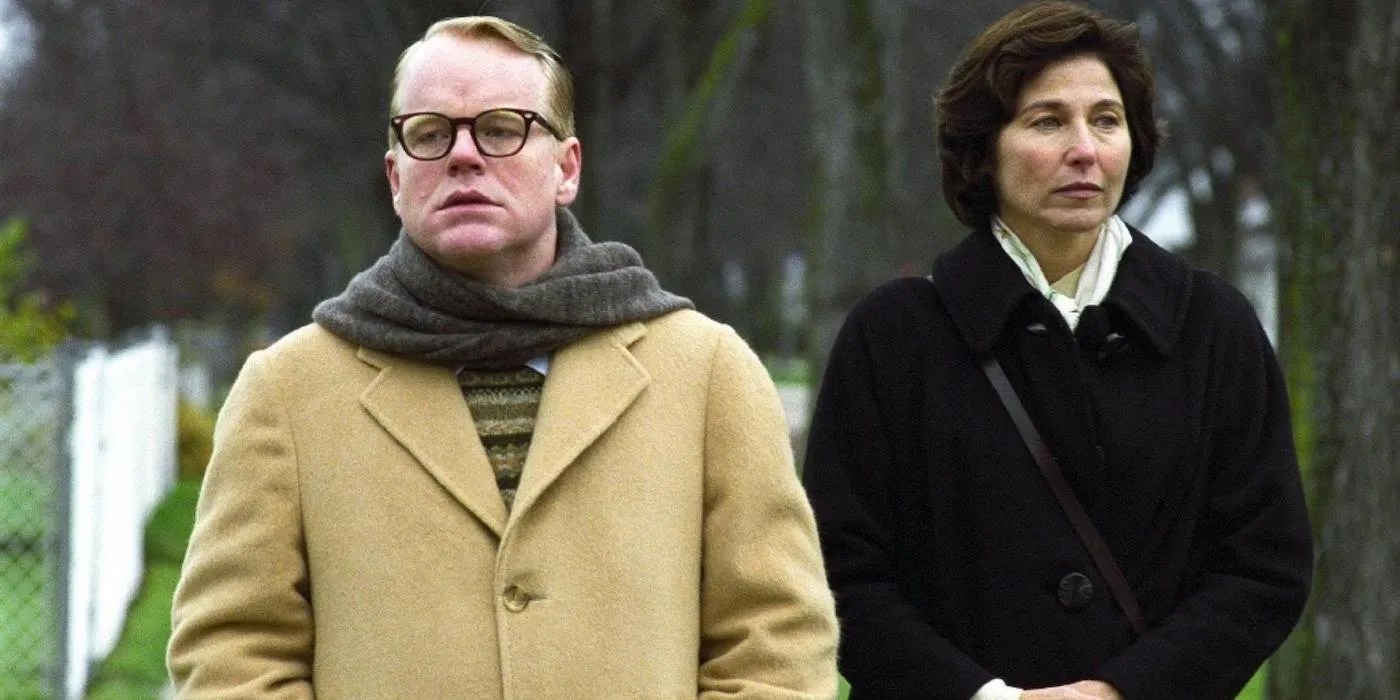
After such a shocking event, it’s human nature to need to know the who and why of it all. Traveling with good friend Nell Harper Lee (Catherine Keener), Capote arrives in Holcomb to find a town in a state of shock. No one wants to think that something so evil and destructive can happen where they live, especially in a rural farming community like Holcomb. When Capote and Lee first arrive, they are not dissimilar to how most of us are when we watch an episode ofDateline,Snapped, or any one of the hundreds of true crime shows that are ubiquitous in today’s entertainment zeitgeist. It’s clear that they are little more than voyeurs. Akin to observers at a zoo, eager to see the dangerous and exotic animals, but only from the safety of outside their cages. They even snicker at a headline that features the K.B.I. (Kansan Bureau of Investigation) showing a snooty and urbane lack of empathy. Initially, it’s pretty clear that Capote has little or no understanding of the devastating impact that the murders have had on the people of Holcomb and the state of Kansas.
A Responsibility to Find and Tell the Truth
Some, like the local sheriff, Alvin Adams Dewey (Chris Cooper), aren’t keen on Capote’s misguided motivations and are less than forthcoming about details on the search for the yet-to-be-apprehended killers. Others, like the sheriff’s wife, Marie Dewey (Amy Ryan), are a little starstruck by the big-city socialite and his engaging, name-dropping yarns of Hollywood stars and starlets. It’s only after the capture of the two murderers, and seeing the two young men in the flesh, that the reality of the horrendous actions begins to sink in for Capote. When he first visits a somber Smith in Olathe, Kansas, and is in the presence of someone so wicked, he is convinced that he has a responsibility to capture the essence of the monster. From that point on, the film and the author’s focus pivot to a more serious and somber tone. He feels the weight of having to relay the nefarious facts to a confused and frightened public. The kind of facts that make us want to know every grisly detail.
Capote’s Interviews With the Killers
Before the bright lights, the cameras, and theKeith Morrisonface-to-face jailhouse interviews we see on the true crime shows of today, there were simple, solitary prison interviews. Capote has little more than pen and paper as he interviews Perry Smith in an effort to pull whatever information he can from the troubled loner. With every misfortune and every tale of a difficult home life, Capote is there to capture and craft a narrative to relay to an eager editor and viewership dying to be entertained by the darkness of his soul. There is a clear intent behind Capote to illustrate a pronounced detachment from us, the observers, and the true brutality of the crime. We crave the gruesome answers, but only if they’re framed in a nice, palatable package that is easy to digest after a good meal. We rarely give much thought to the lives and generations of families that have been ripped apart.
The interviewing of Smith and Hickok spans a period of more than three years. With both men refusing to go into detail about how the events unfolded that tragic evening, Capote grows impatient, but he also begins to develop a soft spot for Perry Smith. Having met with him so many times and interviewing members of his family, Capote grows to see Smith as a human being. He now sees him as more than just a subject, a monster to dissect and psychoanalyze. When the two exhaust all their appeals, Capote’s glib, metropolitan attitude has all but vanished. When they are hung for their crimes, Capote is struck with profound sadness. The entire process of creating In Cold Bloodhas changed him. After its publication in 1965, a full six full years after the massacre, he never published another work.

Our Fascination With True Crime Is Stronger Than Ever
The issues brought to light byCapote,and how we view modern true crime are easy to see. Our inherent fascination with the evil that people do to one another is undeniable. We crave the exploration of every macabre corner of a criminal’s mind, to look very carefully at every dark nook and twisted cranny and then hold ourselves up against them in comparison. We all seem to have a basic need to see what happens when people act on the horrible thoughts that we all share to some degree, but never act on, and ensure there are consequences.Capoteis less about howIn Cold Bloodcame to be and more of a commentary on why we get such a vicarious thrill from getting comfortable on our cozy sofas and are entertained by how and why people are capable of taking the next deadly step and committing unspeakable acts.

